
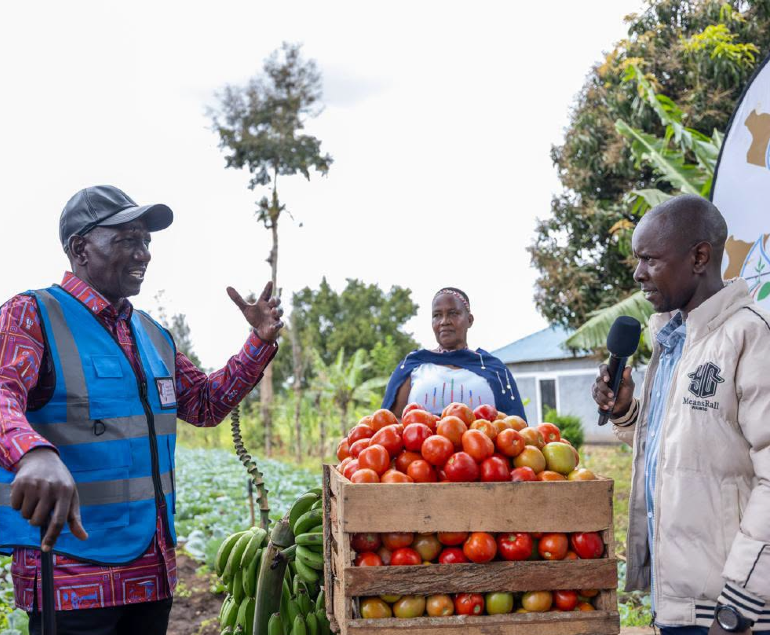
H.E. HON. WILLIAM SAMOEI RUTO, PHD., C.G.H., PRESIDENT OF THE REPUBLIC OF KENYA AND COMMANDER-IN-CHIEF OF THE DEFENCE FORCES, COMMISSIONS THE 5,500-ACRE ROMBO CLUSTERS (KISIOKI) IRRIGATION DEVELOPMENT PROJECT IN KAJIADO COUNTY.
Today H.E. Hon. William Samoei Ruto, PhD., CGH. President of the Republic of Kenya and Commander-In-Chief of the Kenya Defence Forces commissioned Rombo Clusters (Kisioki) Irrigation Development Project in Rombo Ward, Kajiado South Constituency, Kajiado County.
He was received by the Cabinet Secretary for Water, Sanitation and Irrigation, Eng. Eric Mugaa, Principal Secretary State Department for Irrigation, CPA Ephantus Kimotho CBS, the Authority’s Chairman of the Board, Eng. Gilbert Maluki, the Chief Executive Officer, Eng. Charles Muasya, MBS, NIA Board members, Management, local leaders and other senior government officials.
The project, drawing water from permanent springs including the Oljoro springs will irrigate a total of 5,500 acres across the Kisioki, Matepes, Esosioni and Oltepesi irrigation schemes.
With an estimated gross income of KES 1 billion from high-value horticultural crops, staple food crops, fruit trees, and livestock production, the project is set to create 6,000 direct jobs and 30,000 indirect jobs, significantly boosting local employment and food security.
The financial and economic analysis confirms the project’s viability, with a payback period of less than one year. Phase 2 will put an additional 5,000 acres under irrigation, reinforcing the government’s Bottom-Up Economic Transformation Agenda.
Key infrastructure includes extensive intake works, auxiliary structures and over 19.8 km of lined main and branch canals ensuring efficient water delivery.
Works on the Kisioki and Oltepesi schemes are 100% complete, with Esosioni at 99.5% and Matepes at 95%, targeting full completion by October 2026. Next steps include strengthening the capacity of the Irrigation Water Users Association (IWUA), providing quality input support, enhancing post-harvest handling facilities and rolling out Phase 2 to maximize the project’s economic impact.
This project underscores Kenya’s commitment to sustainable agriculture, wealth creation and food security as espoused in the Bottom-Up Economic Transformation Agenda (BETA).